
How to Make Math Fun for Kids Who Say They Hate It
How to make math fun for kids who hate it: find out why they dislike it, then use games, real-life maths and short sessions to rebuild their confidence.
If your child groans the moment the maths book comes out, you are in good company. Most advice on how to make math fun for kids jumps straight to games. Games help, but they work much better once you know why your child dislikes maths in the first place. A child who is bored needs something different from a child who is lost or scared of getting it wrong.
This guide starts with that question, then gives you games, everyday activities and a gentle first week you can try at home.
Why kids say "I hate math"
"I hate math" usually means one of these:
- They are stuck on an earlier skill. A child who still counts on their fingers for 7 + 5 will find column addition or times tables exhausting. The new topic feels impossible because the old one never settled.
- They are worried about being wrong. Timed tests, red crosses and being slow in front of classmates can make maths feel like a place where you get caught out.
- They are bored. Some children find worksheets repetitive, especially if they already know the facts and are made to repeat them.
- They have picked it up from someone. Children notice when adults say "I was never a maths person".
- The sessions are too long. Forty minutes of homework at the end of a school day would put most adults off too.
Watch your child for a week before changing anything. When do the complaints start? Is it one kind of question, or any maths at all? Do they enjoy numbers in games but not on paper? The answers tell you which of the fixes below to try first.
If the problem shows up only at school, a short chat with the teacher often explains a lot. If your child struggles with very basic number sense (which of two numbers is bigger, counting objects reliably) well past their age group, ask the school about an assessment.
Fix the gap before adding fun
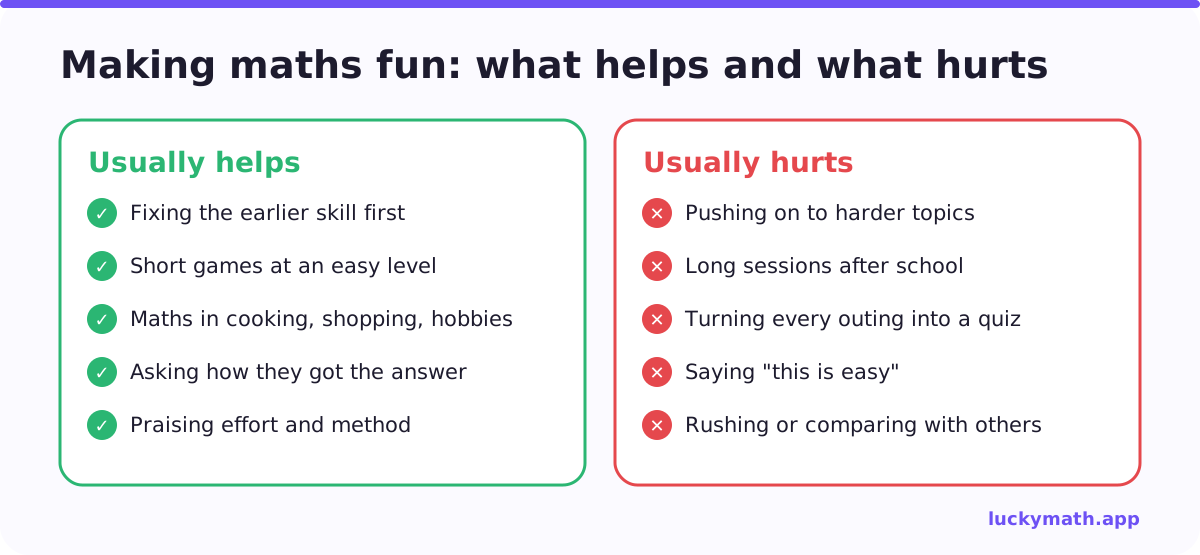
Games will not cover a missing foundation for long. If your child is stuck, go back a step and make that step feel easy.
- Find the last thing they can do comfortably. Ask a few quick questions out loud, starting easy. Stop at the first level where they hesitate or guess.
- Practise at and just below that level. A child who gets eight out of ten right is far more willing to try the next two.
- Move up in small steps. When the current level starts to bore them, it is time to move on.
A child who hates times tables may not have number bonds to 10 secure yet. Ten minutes a day on bonds for two weeks can do more for their mood than any times tables game. Once bonds are solid, times tables become much easier to start.
Math games that need almost nothing
These suit ages 5 to 10 and take five to ten minutes.
- Dice war. Each player rolls two dice and adds them (or multiplies them for older kids). Highest total wins the round. Add a third die when it gets easy.
- Make ten. Lay out playing cards ace to 9 face up. Take turns picking two cards that add to 10. Change the target to 20 with three cards later.
- Shop. Price a few toys or snacks with sticky notes and give your child coins. They buy, you give change, then swap roles.
- Guess my number. Think of a number up to 100. Your child asks questions like "Is it more than 50?" or "Is it even?" until they find it.
- Snakes and ladders with a twist. Before moving, your child says where they will land. Wrong guesses still move, so nobody loses a turn.
- Speed race against themselves. Time how long it takes to answer ten easy questions, then try to beat that time tomorrow. They compete only with their own past score.
Let your child win often at the start, and let them make up rules. A game they helped design gets played more.
Bring maths into everyday life
Real-life maths does not feel like homework, and it answers the old "when will I ever use this?" complaint.
- In the kitchen: double a recipe, count spoonfuls, cut a pizza into halves and quarters.
- At the shop: "We have 20 to spend. Can we buy both?" Let them hold the money.
- In the car: add the digits on number plates, count red cars, estimate how many minutes until you arrive.
- With their hobby: football scores, Minecraft blocks, Lego bricks or song lengths all work. A child who loves football may enjoy working out goal differences more than any worksheet.
Keep it light. One or two questions while you cook is plenty. If every outing turns into a quiz, they will notice.
Change how you talk about maths
What you say during practice matters as much as what you practise.
| Instead of | Try |
|---|---|
| "This is easy." | "This one takes a bit of thinking." |
| "I was rubbish at maths too." | "I had to practise this a lot when I was your age." |
| "You're so clever!" | "You kept trying different ways until it worked." |
| "No, that's wrong." | "Show me how you got that." |
| "Hurry up." | "Take your time. I'll wait." |
Asking how they got an answer often shows you the exact mistake, and the child may spot it themselves while explaining. Praise the method and the effort more than the speed.
A gentle first week
Start small. The aim this week is a calmer mood around maths, so keep the work light.
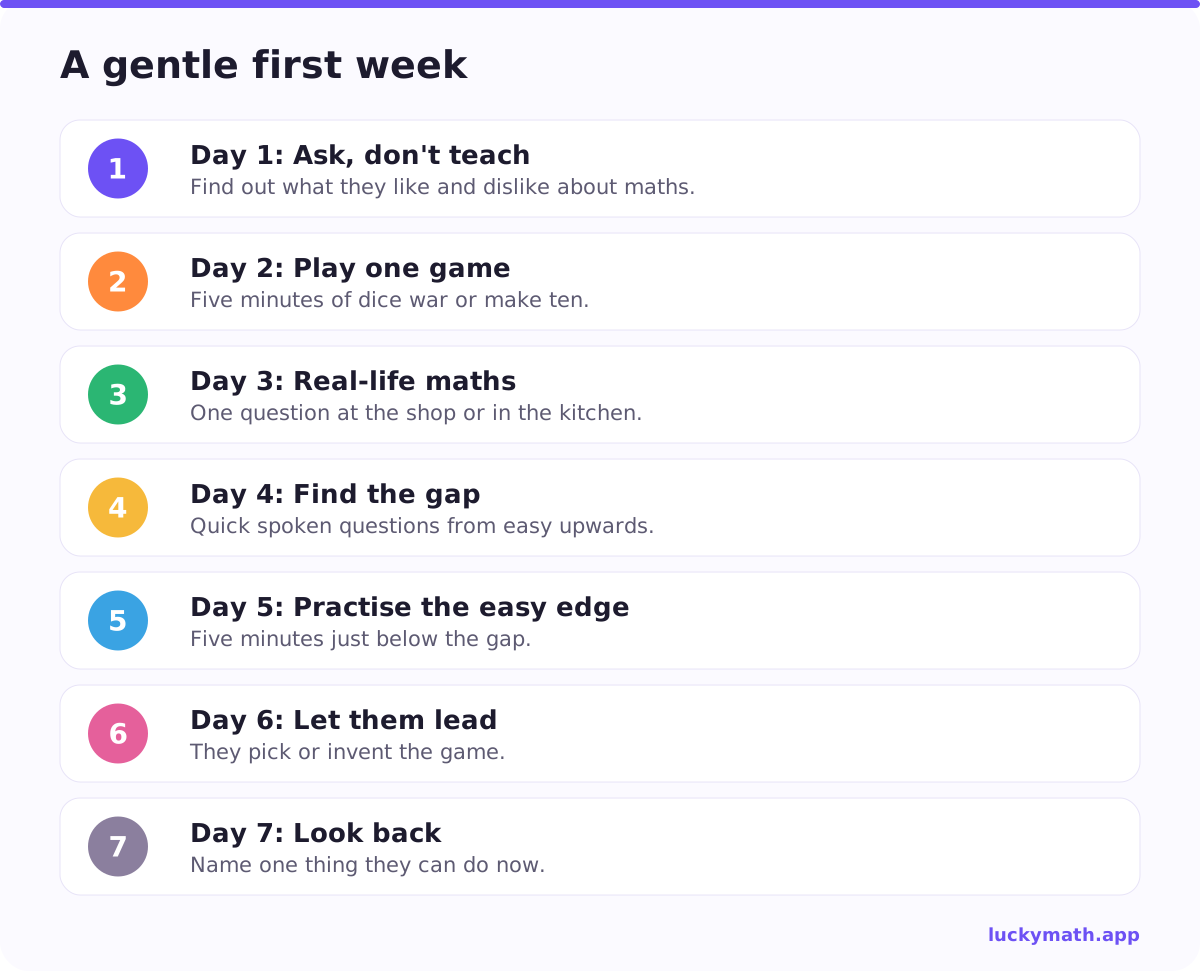
- Day 1: Ask, don't teach. Ask your child what they like and dislike about maths. Just listen.
- Day 2: Play one game. Pick dice war or make ten. Five minutes, then stop while they are still enjoying it.
- Day 3: Real-life maths. One question at the shop or in the kitchen.
- Day 4: Find the gap. A few quick spoken questions from easy upwards. Note where they slow down.
- Day 5: Practise at the easy edge. Five minutes on the skill just before the gap, with a game.
- Day 6: Let them lead. They choose the game or make up a new one.
- Day 7: Look back. Point out one thing they can do now that they couldn't on Monday.
After that, keep sessions short. For most primary-age children 5 to 15 minutes a day is enough; see how long kids should practise math by age for a fuller guide. A small reward for showing up regularly can help in the early weeks, as long as it is for effort rather than perfect scores. Our guide on rewards for math practice explains what works.
When a quiz app can help
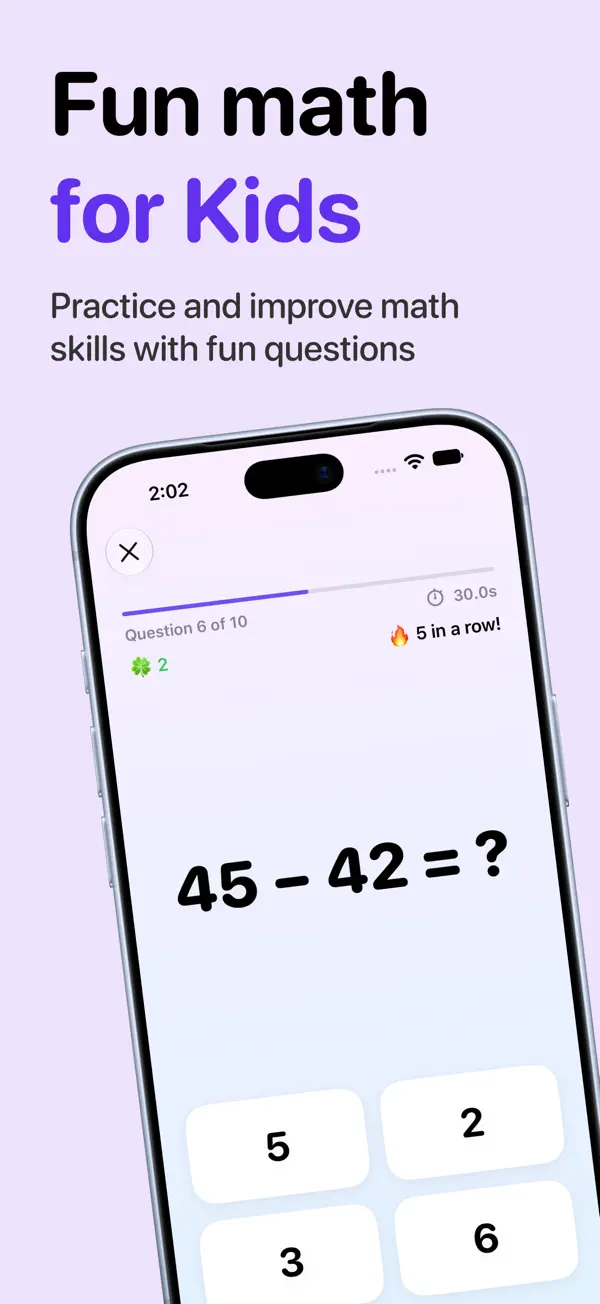
Some children who freeze on paper relax with short quizzes on a screen, especially if there is something to look forward to at the end. Lucky Math is our iPhone app built for that. Kids answer a quick quiz, and a good score opens a lucky chest with a real reward that you set (a park trip, choosing dinner, a sticker). Addition and subtraction are free. Lucky Math Plus adds multiplication and division, an Apple Watch app and family sharing, so siblings can each have their own profile.
FAQ
Why does my child suddenly hate maths?
A sudden change often follows a new topic that builds on a skill they never fully learned, a harder class, timed tests, or a bad experience in front of others. Ask them what happened, and check whether the basics from the year before are secure.
What is the easiest way to make maths fun at home?
Short games with dice or cards, five to ten minutes at a time, at a level where your child gets most answers right. Stop while they are still enjoying it so they want to play again.
Should I force my child to do maths practice?
Keep a regular, short routine, much as you would for reading, but make the sessions small enough that they are not a battle. Five calm minutes a day does more than a 40-minute argument.
When should I worry that it is more than dislike?
If your child has persistent trouble with basic number sense, such as comparing two numbers or counting objects, well beyond their age group, or if maths causes real distress, talk to their teacher about an assessment.


