Number Bonds to 10 and 20: What They Are and How to Teach
Number bonds to 10 and 20 explained for parents: what they are, why they matter, the order to teach them, and quick games to make the pairs automatic at home.
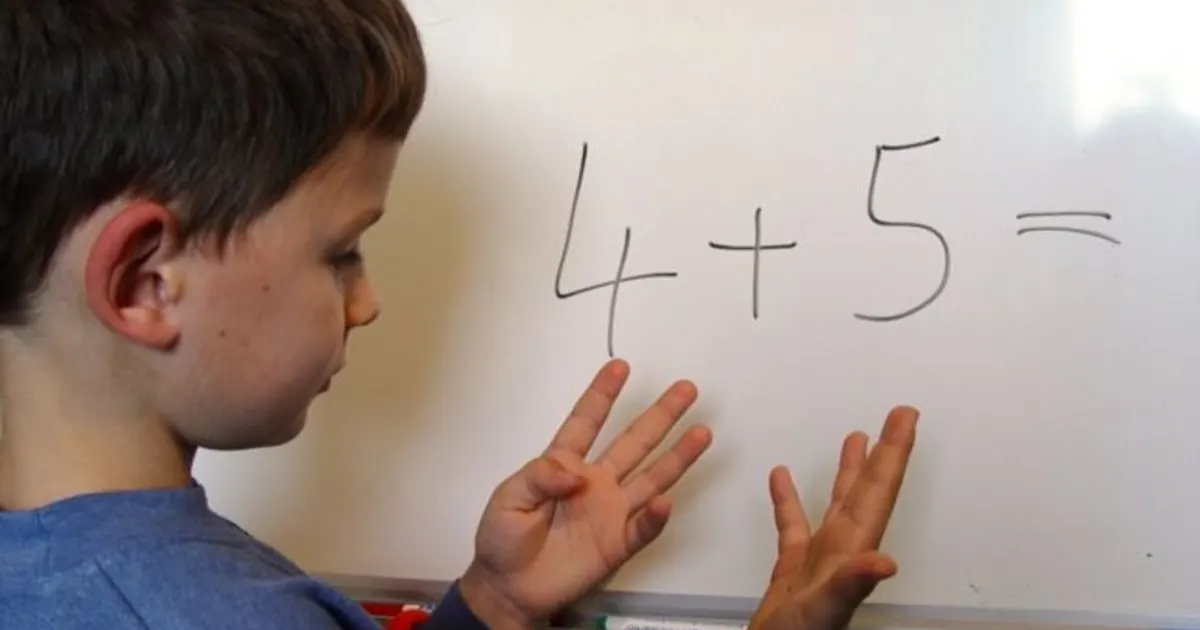
Number bonds to 10 and 20 are the pairs of numbers that add up to 10 or 20: 3 and 7, 6 and 4, 13 and 7, 18 and 2. If your child's school sends home a "number bonds" sheet, this is what it means. In the US you may hear them called "make 10 facts" or addition fact families.
Most of what you find online is worksheets and school handouts. This guide explains what the bonds are for, the order to teach them, how to tell when your child really knows them, and games that need nothing more than your hands or a pack of cards.
What number bonds are
A number bond shows how a number splits into two parts. Teachers often draw it as three circles: the whole at the top, the two parts below.
10
     /  \
    7    3
One bond gives four facts at once: 7 + 3 = 10, 3 + 7 = 10, 10 - 7 = 3 and 10 - 3 = 7. That link between adding and taking away is the main reason schools teach bonds instead of separate addition and subtraction lists.
There are only six pairs to learn for 10 (0+10, 1+9, 2+8, 3+7, 4+6, 5+5), plus their swapped versions. Bonds to 20 come almost free once those are solid.
Why number bonds matter
A child who knows bonds to 10 without counting can do much harder sums in their head. Three examples:
- Bridging through 10. For 8 + 5, they think "8 needs 2 to make 10, then 3 more": 13. This is how most adults add small numbers mentally.
- Subtraction. 10 - 6 becomes "what goes with 6 to make 10?" instead of counting back six steps.
- Bigger numbers. 7 + 3 = 10 leads straight to 17 + 3 = 20, 70 + 30 = 100 and later 0.7 + 0.3 = 1.
A child who still counts every sum on their fingers can get the right answer, but slowly, and the effort leaves less room for the actual problem. Our guide on how to make math fun for kids who hate it explains why a shaky earlier skill like this is often behind "I hate maths".
The order to teach them
Go in small steps and only move on when the current step feels easy.
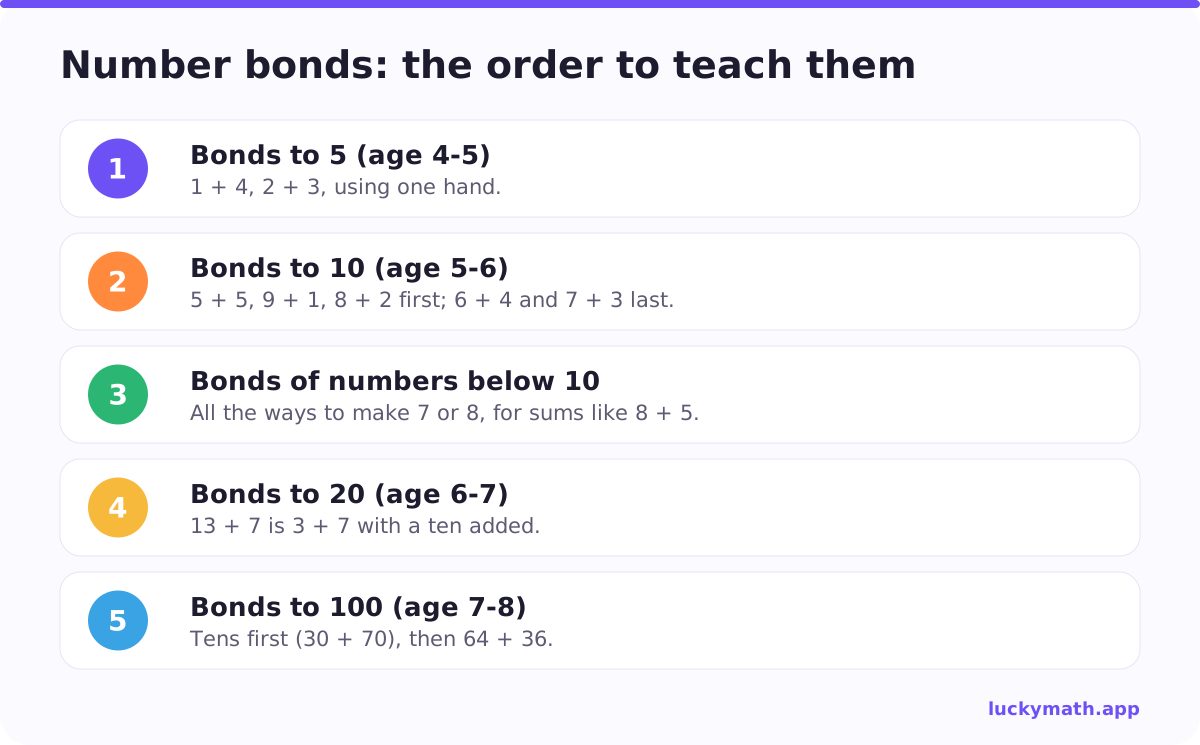
- Bonds to 5 (age 4-5). 1 and 4, 2 and 3. Use fingers on one hand: hold up 3, how many are down?
- Bonds to 10 (age 5-6). Start with the doubles 5+5, then 9+1 and 8+2, which most children find easiest. Leave 6+4 and 7+3 until last.
- Bonds of numbers below 10 (age 5-6). All the ways to make 7 or 8 (5+3, 6+2, 4+4). These help with sums like 8 + 5.
- Bonds to 20 (age 6-7). Show that 13 + 7 is the 3 + 7 bond with a ten added. Practise both kinds: 13 + 7 and 9 + 11.
- Bonds to 100 in tens, then in ones (age 7-8). 30 + 70 first, then trickier pairs like 64 + 36.
Ages are rough. In England, the national curriculum covers bonds within 20 in Year 1 and expects quick recall of them in Year 2. Other countries vary. Your child's current skill matters more than their age.
How to teach number bonds at home
Use something your child can see and move, then fade it out.
- Ten frame. Draw a 2 by 5 grid on paper and fill some squares with coins or buttons. "Six are full. How many empty?" Children start to see 6 and 4 without counting.
- Fingers. Ten fingers is a ready-made ten frame. Hold up seven: how many are folded?
- Two colours of Lego or beads. Build a tower of 10 in two colours and count the parts. Then swap the colours round.
- Say it all four ways. After each pair, say the two additions and the two subtractions out loud.
Once your child can find bonds with objects, start hiding them. Cover some coins with your hand: "There are 10 altogether. I can see 3. How many under my hand?" This step from seeing to knowing usually takes the longest.
Games that make the bonds automatic
Five minutes a day is plenty. Pick one game and stop while it is still fun.
- Make ten (cards). Remove picture cards. Lay out 12 cards face up and take turns finding two that make 10. Replace them from the pack. For 20, use three cards or count picture cards as 10.
- Ten pairs memory. Lay cards face down and turn two over at a time. A pair that makes 10 is a match.
- Bond ping-pong. You say a number, your child says its partner to 10 as fast as they can. Swap roles so they test you too.
- Hidden counters. The covered-coins game above, with 10 and later 20 coins.
- Shop for 20. Give your child 20 cents or 20 sen in coins and price small items. "This costs 13. What change do you get?"
- Clap the partner. You clap 4 times, they clap the rest up to 10.
For older children who find bonds too easy, try bonds to 100 with ping-pong ("35!" "65!"), or bonds to 1 with decimals.
How to tell your child really knows them
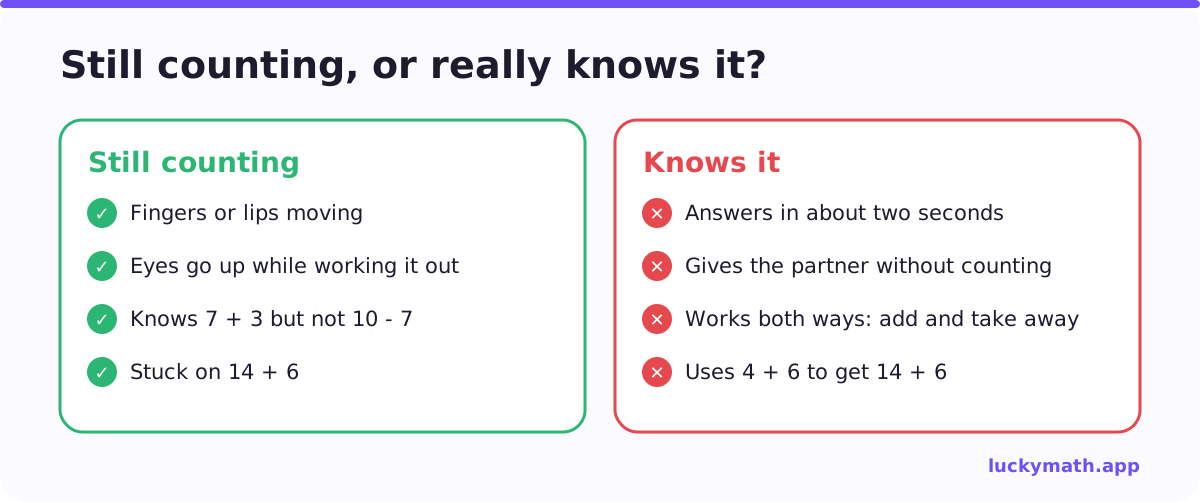
Knowing a bond means answering in about two seconds without counting. Watch for fingers moving, lips counting or eyes going up while they work it out. Those are signs the fact is still being calculated, which is fine for now but not the goal.
A quick check: ask ten random bonds to 10, mixed in both directions ("7 and what?", "10 take away 4?"). If your child answers most of them straight away, move to bonds to 20. If not, keep going with games for another week or two.
Common sticking points:
- 6 + 4 and 7 + 3 are the ones most often counted. Practise them more.
- Subtraction form. Some children know 7 + 3 but freeze on 10 - 7. Ask both.
- Bonds to 20 with teens. If 14 + 6 is hard, go back to 4 + 6 and show the link with a ten frame plus a full ten.
Short daily sessions work better than one long one. See how long kids should practise math each day for times by age.
Practising number bonds with an app
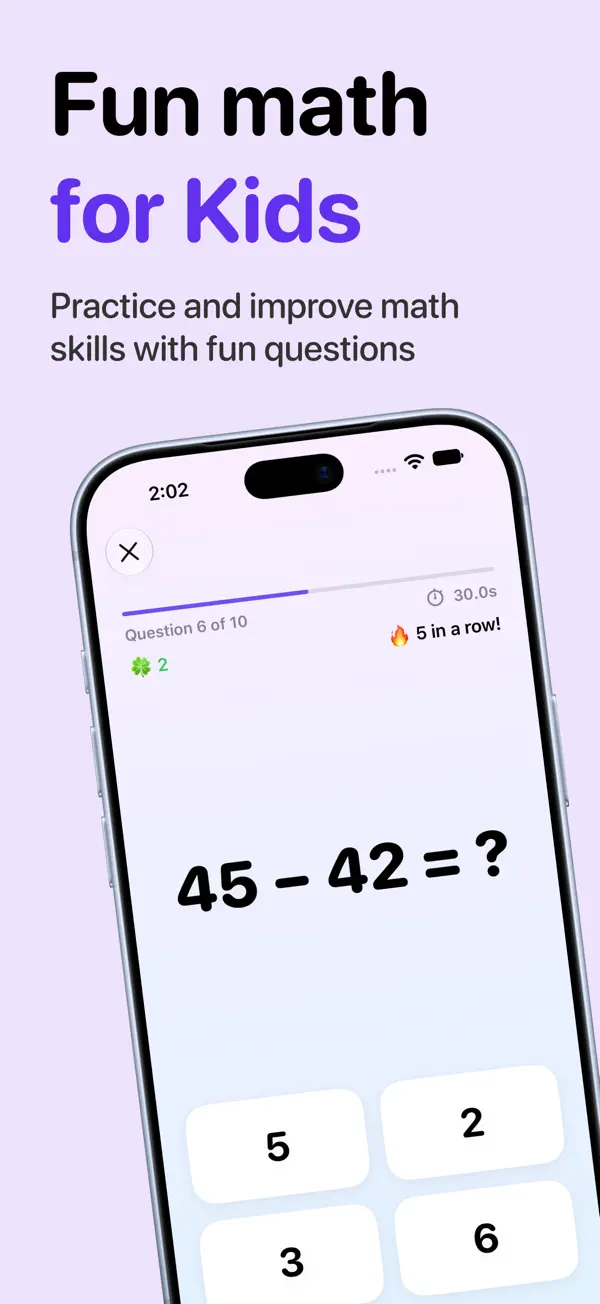
Some children like a short quiz on a screen as a change from cards. Lucky Math is our iPhone app for quick daily practice. Kids answer a short quiz, and a good score opens a lucky chest with a real reward you choose. Addition and subtraction, which cover all the number bond facts, are free. Lucky Math Plus adds multiplication and division, an Apple Watch app and family sharing for siblings.
FAQ
What are number bonds to 10?
The pairs of whole numbers that add up to 10: 0 and 10, 1 and 9, 2 and 8, 3 and 7, 4 and 6, and 5 and 5. Each pair also gives two subtraction facts, such as 10 - 3 = 7.
What age should a child know number bonds to 20?
Many children work on bonds to 10 around age 5 to 6 and bonds to 20 around age 6 to 7. In England they are expected to recall bonds within 20 quickly by Year 2. Go by your child's current skill rather than the age.
Are number bonds the same as fact families?
They are closely related. A number bond shows a whole and its two parts, such as 10, 7 and 3. A fact family lists the four sums those numbers make: 7 + 3, 3 + 7, 10 - 3 and 10 - 7.
Is it bad if my child uses fingers for number bonds?
Fingers are a good way to start, because ten fingers show bonds to 10 directly. The aim is to move from counting fingers to just knowing the pair, which comes with short, regular games.