9 Times Table Trick: Finger Method and Patterns That Stick
The 9 times table trick on your fingers, why it works, three patterns that help kids remember, and how to stop relying on fingers once the facts are known.

The 9 times table trick is the one most children remember from school: hold up ten fingers, fold one down, and the answer appears on your hands. It takes about two minutes to teach, and for many children it is the first time a times table feels like fun.
Most pages stop at the trick. This guide also shows why it works, the patterns in the 9s that help when fingers aren't allowed, what to do for 9 × 11 and 9 × 12, and how to move from fingers to instant recall.
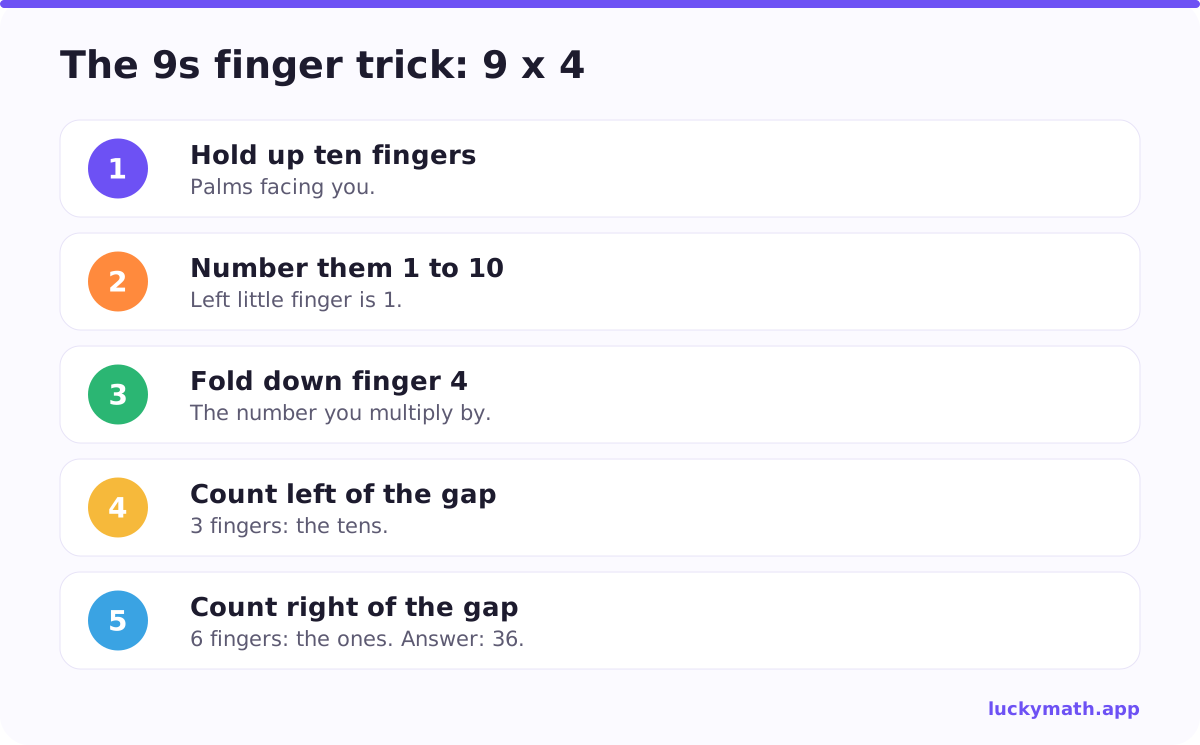
The finger trick, step by step
- Hold up both hands with your palms facing you and all ten fingers spread.
- Number your fingers 1 to 10 from left to right. Your left little finger is 1, your right little finger is 10.
- Fold down the finger you are multiplying by. For 9 × 4, fold down finger 4.
- Count the fingers to the left of the gap. That is the tens digit: 3.
- Count the fingers to the right of the gap. That is the ones digit: 6.
So 9 × 4 = 36. Try 9 × 7: fold finger 7, and you have 6 on the left and 3 on the right, which gives 63. For 9 × 10, fold your last finger: 9 on the left, none on the right, so 90.
Children often go wrong by starting from the wrong hand, or by counting the folded finger. Put a small sticker or pen dot on the left little finger for the first few tries, and have them say "tens" and "ones" out loud as they count each side.
The trick covers 9 × 1 to 9 × 10. It only works for the 9s, which sometimes disappoints children who try it on the 8s.
Why the finger trick works
Older children enjoy knowing it isn't magic. Multiplying by 9 is the same as multiplying by 10 and taking one lot away: 9 × 4 is 40 - 4 = 36.
When you fold finger 4, there are 3 fingers on the left. That is always one less than the number you folded, which matches the tens digit. The fingers on the right are always what is left of the ten, 10 - 4 = 6, which matches the ones digit.
Explaining this also gives your child a second method. Once they see that 9 lots is "10 lots minus one lot", they can work out any 9s fact, including ones past 10.
Patterns in the 9 times table
Write the table out with your child and ask what they notice. Finding the patterns themselves helps them stick.
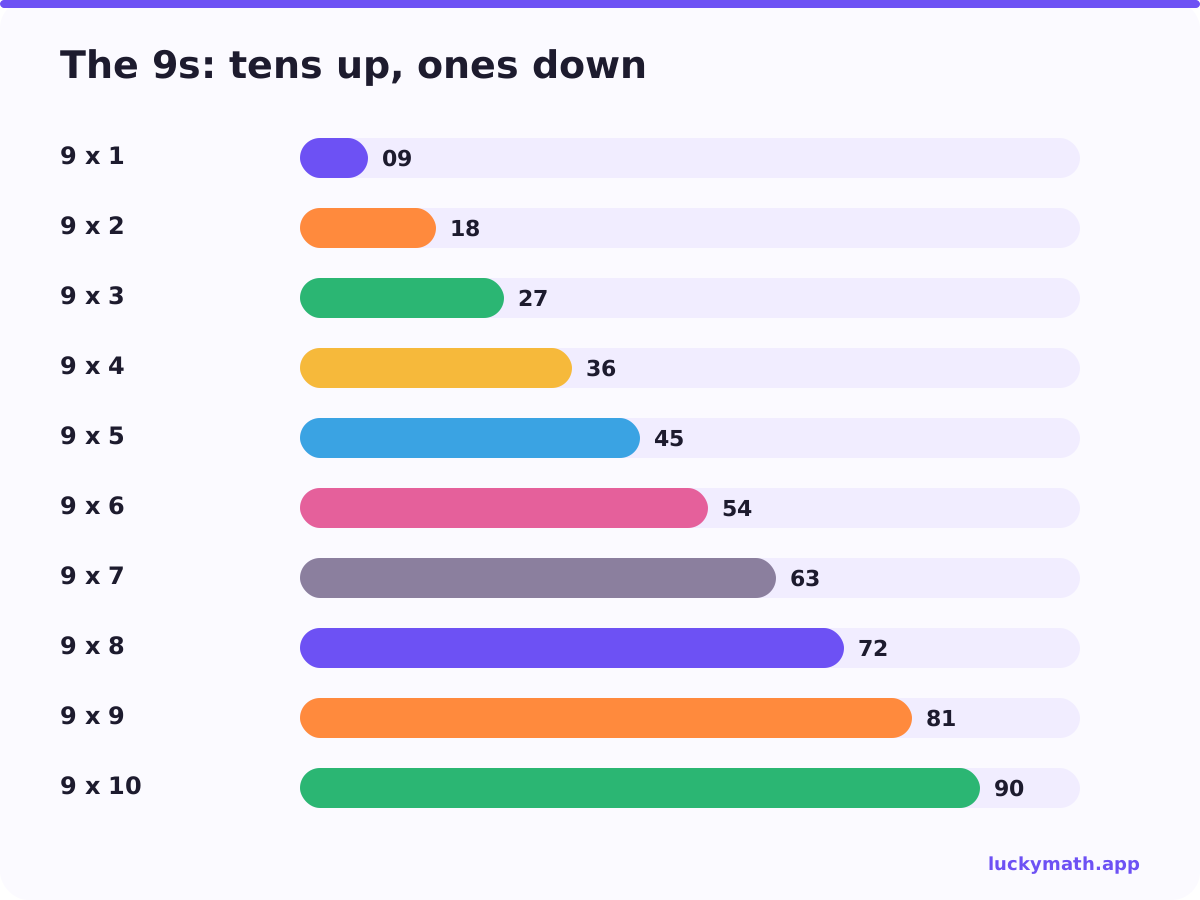
| Fact | Answer | Digits add to |
|---|---|---|
| 9 × 1 | 09 | 9 |
| 9 × 2 | 18 | 9 |
| 9 × 3 | 27 | 9 |
| 9 × 4 | 36 | 9 |
| 9 × 5 | 45 | 9 |
| 9 × 6 | 54 | 9 |
| 9 × 7 | 63 | 9 |
| 9 × 8 | 72 | 9 |
| 9 × 9 | 81 | 9 |
| 9 × 10 | 90 | 9 |
- The tens digit is one less than the number you are multiplying by. For 9 × 6, the tens digit is 5.
- The two digits add up to 9. If the tens digit is 5, the ones digit must be 4, so 9 × 6 = 54.
- The tens go up by one while the ones go down by one. Reading down the table, one column climbs from 0 to 9 and the other falls from 9 to 0.
- The second half mirrors the first: 18 and 81, 27 and 72, 36 and 63, 45 and 54.
The first two patterns together are a finger-free trick. For 9 × 8, your child thinks "one less than 8 is 7, and 7 needs 2 to make 9", which gives 72. It relies on knowing pairs that make 9, so if those are shaky, practise them first. Our guide to number bonds has games that work for this too.
What about 9 x 11 and 9 x 12?
The finger trick runs out at 10, and the "one less" pattern stops working too. Use the 10 lots method instead:
- 9 × 11 = 110 - 11 = 99
- 9 × 12 = 120 - 12 = 108
The digits of 99 don't add to 9, though 108 does (1 + 0 + 8). Many schools expect tables up to 12 × 12, while others stop at 10, so check what your child's class uses.
From fingers to instant recall
The trick is a good way in, but counting fingers in the middle of a long multiplication sum is slow. Aim for your child to know the 9s without thinking.
- Week 1: use fingers freely. Ask 9s questions in any order. The goal is confidence and getting every answer right.
- Week 2: say the answer, then check. Your child guesses first, then uses fingers to confirm. Often the guess is already right.
- Week 3: pattern only. Hands under the table. They use "one less, then add up to 9".
- Week 4: mix them in. Put 9s in among tables they already know, so they have to recall them at random.
Five minutes a day is enough. Teach the 9s after the 2s, 5s, 10s, 3s and 4s, so your child already knows most of the facts from the other side: 9 × 2 is the same as 2 × 9. Our step-by-step guide to teaching times tables gives the full order.
Practising the 9s with an app
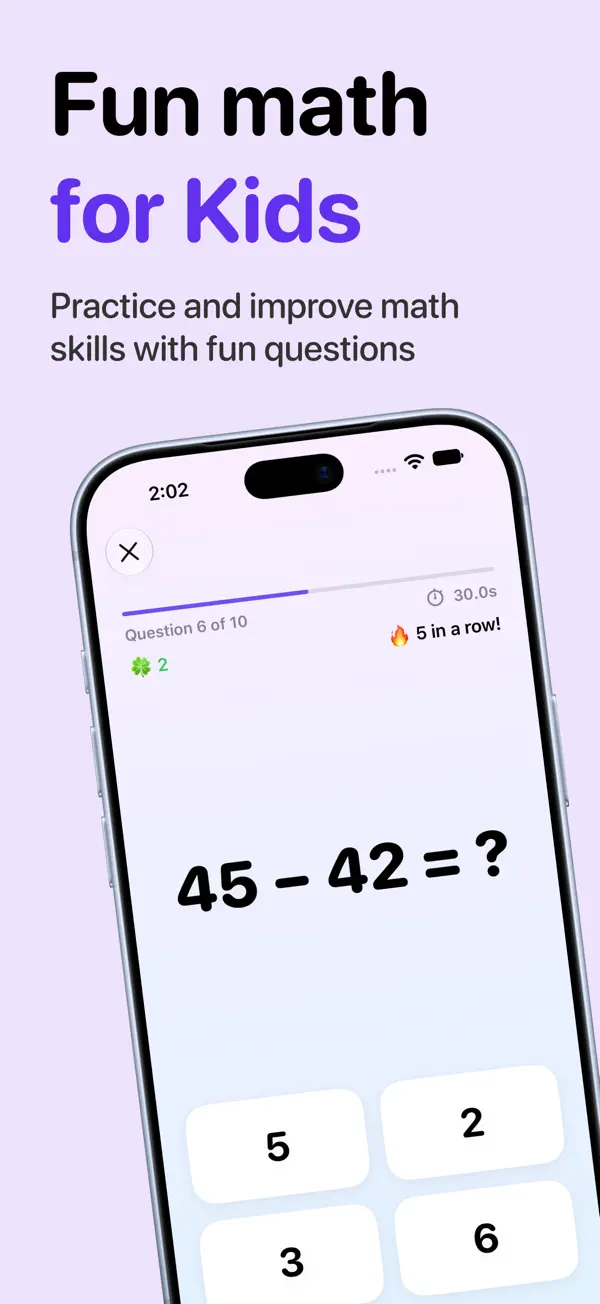
For the mixed practice in week 4, a short quiz works well. Lucky Math is our iPhone app for quick daily practice: kids answer a short quiz, and a good score opens a lucky chest with a real reward you choose. Addition and subtraction are free. Multiplication and division are in Lucky Math Plus, along with an Apple Watch app and family sharing.
FAQ
What is the trick for the 9 times table?
Hold up ten fingers and number them 1 to 10 from the left. Fold down the finger you are multiplying by. The fingers on the left of the gap are the tens and the fingers on the right are the ones. For 9 × 6, you get 5 and 4, so 54.
Does the finger trick work for other times tables?
Not in this form. It only works for the 9s, from 9 × 1 to 9 × 10. There is a separate finger method for 6 to 10, but it is harder and most children do better learning those facts another way.
Is the finger trick cheating?
No. It gives correct answers and helps a child see the pattern. It is a starting point, though, so move on to recall once your child is confident, because fingers are too slow for long multiplication and division.
What age should a child learn the 9 times table?
It depends on your country. In England the 9s are expected by the end of Year 4, around age 8 to 9, as part of all tables up to 12 × 12. Other countries vary, and many teach it earlier. Go by whether your child already knows the easier tables.