Child Still Counts on Fingers? How to Help Them Move On
Your child counts on fingers for every sum? Why it happens, when it is normal, and step-by-step ways to help them move from fingers to mental maths.
If your child counts on fingers for every sum, even 5 + 3, you may wonder whether it is a habit to break. Usually it is a normal stage. Fingers are the first calculator most children have, and research suggests using them early helps. What you want is for your child to need them less over time, for the small facts first.
This guide covers when finger counting is normal, when it is holding a child back, and how to help them move on without making them feel bad about it.
Is it bad if my child counts on their fingers?
No, especially for children aged 4 to 7. A Swiss study by Krenger and Thevenot, published in Developmental Psychology in 2025, followed children from about age 4 to 7 and tested their addition several times. Children who counted on their fingers early and later stopped did better at addition than both children who had never used their fingers and children who were still relying on them.
So fingers help at the start, and the goal is to outgrow them. Telling a five-year-old to "stop using your fingers" removes a tool before something better has replaced it.
When finger counting becomes a problem
Look at how your child uses their fingers, as well as how often:
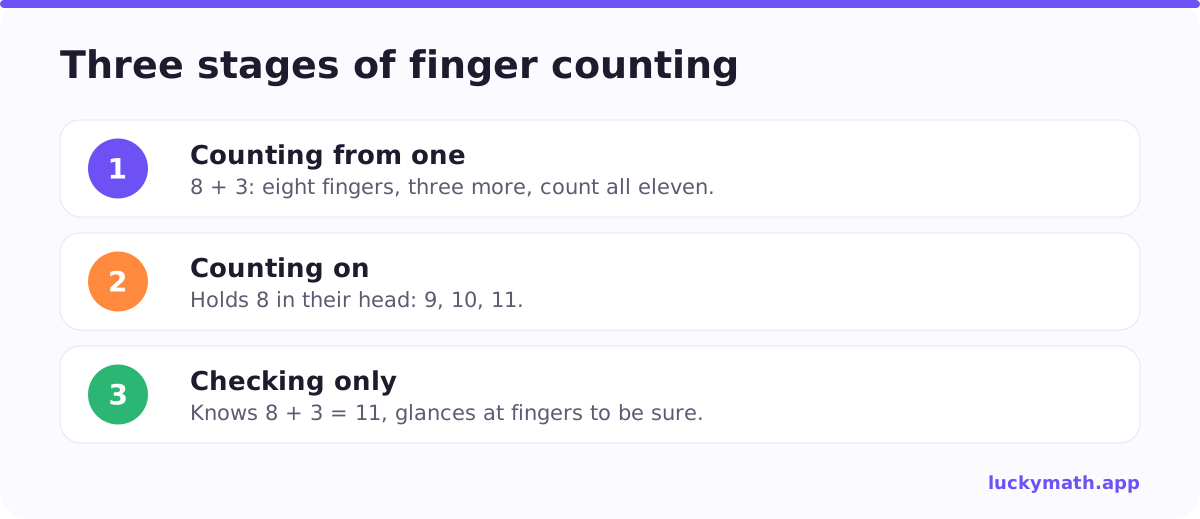
- Counting from one every time. For 8 + 3 they count out eight fingers, then three more, then count all eleven. This is slow and easy to get wrong.
- Counting on. They hold 8 in their head and count "9, 10, 11" on three fingers. Faster, and a sign of progress.
- Using fingers to check. They know 8 + 3 is 11 but glance at their fingers to be sure. Nearly there.
A six-year-old counting from one is normal. An eight- or nine-year-old who still counts from one for small sums like 6 + 4 will find column addition, times tables and word problems slow and tiring, because all their attention goes into the counting. That is the point to help, and if it continues past age 9 it is worth a word with the teacher.
Why some children keep counting on their fingers
Children carry on with fingers when nothing faster is available to them yet. Common reasons:
- They have not learned the small facts by heart, especially number bonds to 10 (7 + 3, 6 + 4).
- They do not "see" small quantities. Shown five dots, they count them one by one instead of recognising five.
- They have never been shown a quicker strategy, such as counting on from the bigger number or using doubles.
- Timed tests or pressure make them anxious, so they fall back on the method that feels safest.
Each reason has a different fix, so it helps to watch for a few days first.
How to help a child stop counting on their fingers
Work through these in order. Each step makes the next one easier.
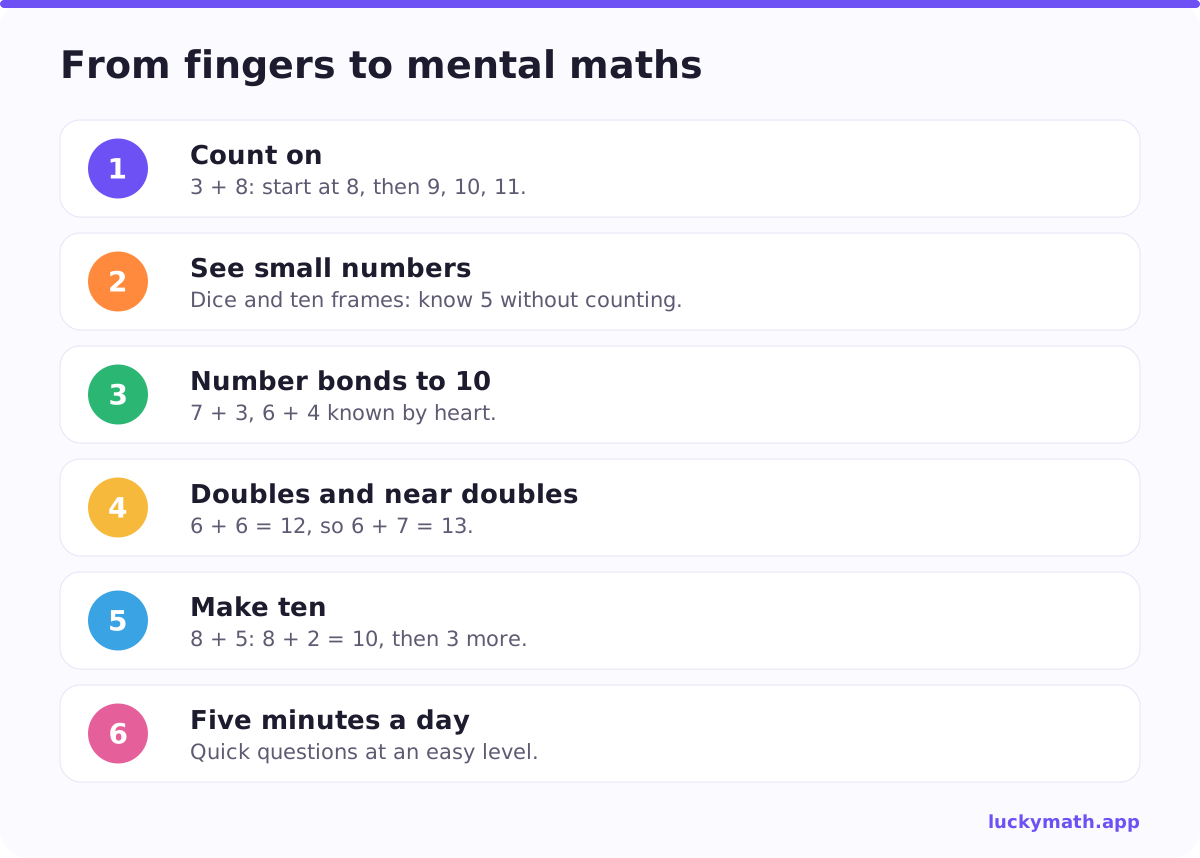
- Teach counting on. For 3 + 8, start at the bigger number and count up: "8... 9, 10, 11." This alone halves the counting for many sums. Practise with a dice game: roll two dice, say the bigger number, then count on the dots of the smaller one.
- Build quick recognition of small numbers. Flash dot patterns (dice, dominoes, fingers held up) for a second and ask "how many?" without counting. Ten frames work well too: a 2 by 5 grid where your child learns that a full top row is 5.
- Learn number bonds to 10. These pairs are the foundation for almost everything else. Our guide on number bonds to 10 and 20 has games for this.
- Teach doubles. 3 + 3, 4 + 4, 5 + 5 up to 10 + 10 are easy to remember, often because of patterns like "double five is ten fingers". Then near doubles: 6 + 7 is double 6 plus one.
- Make ten. For 8 + 5: "8 needs 2 to make 10, then 3 more is 13." Once bonds are secure, this replaces most counting for sums up to 20.
- Practise facts briefly, every day. Five minutes of quick spoken questions or a card game, at a level where your child gets most right. Speed comes from recall, which comes from regular short practice.
Let your child keep using fingers for facts they have not learned yet. As each fact becomes automatic, the fingers drop out for that fact on their own.
What not to do
- Banning fingers or making your child sit on their hands. They lose their only strategy and usually just count in their head more slowly, or guess.
- Making fun of it, or comparing them with a sibling who "doesn't need fingers".
- Long timed drills before the facts are known. Speed tests measure recall; they do not build it, and they make anxious children more anxious.
- Jumping to bigger numbers. If 6 + 4 still needs fingers, 26 + 14 will be painful. Go back to the small facts.
Keep it calm. If your child dislikes maths already, our guide on how to make maths fun for kids who hate it has ideas for getting them back on side first.
A rough guide by age
| Age | What is typical |
|---|---|
| 4-5 | Counting objects and fingers from one. Normal. |
| 5-6 | Starting to count on from a number. Fingers used for most sums. |
| 6-7 | Knows some facts (doubles, +1, +10) by heart. Fingers for the rest. |
| 7-8 | Most facts to 10 known. Fingers occasionally, for checking. |
| 8-9 | Facts to 20 mostly known. Regular counting from one is worth working on. |
Children vary, and these ages are approximate. What matters most is steady progress from one row to the next.
Practising facts with an app
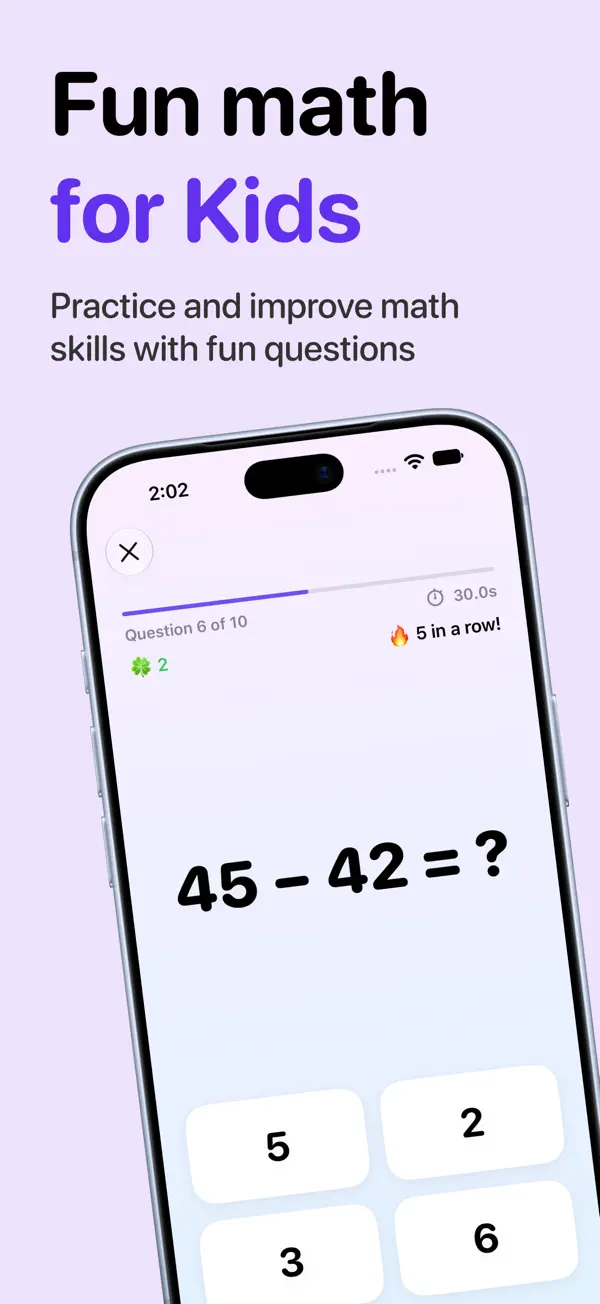
Once your child knows a strategy, short daily practice is what turns it into recall. Lucky Math is our iPhone app for that: a quick quiz at your child's level, and a good score opens a lucky chest with a real reward you choose. Addition and subtraction are free. Lucky Math Plus adds multiplication and division, an Apple Watch app and family sharing, so siblings each get their own profile.
FAQ
At what age should a child stop counting on their fingers?
There is no fixed age. Many children use fingers less from about age 6 to 7 and only occasionally by 7 to 8. If a child of 8 or 9 still counts from one for small sums, help them learn the facts and talk to their teacher if it continues.
Should I tell my child not to use their fingers?
No. Fingers are a useful tool while facts are being learned. Teach faster strategies such as counting on, doubles and making ten, and let the fingers fade as each fact becomes automatic.
Is finger counting a sign of dyscalculia?
Not on its own. Most children count on their fingers at some stage. It is worth asking for an assessment if a child also struggles to compare two numbers, recognise small quantities or remember any facts at all, well beyond their age group.
How do I help my child do maths in their head?
Start with small facts they can learn by heart: number bonds to 10 and doubles. Then teach strategies that build on them, like making ten for 8 + 5. Five minutes of practice a day works better than a long session once a week.