How Long to Learn Times Tables? Free Finish-Date Calculator
How long to learn times tables? Enter what your child knows and your practice time to get a finish date and a free printable week-by-week plan.
Ask how long it takes to learn the times tables and you get a range: a few weeks, a few months, by the end of Year 4. None of those answers use the two things you already know, which are the tables your child has got and the time your family can spare.
Debt calculators deal with the same kind of question. You enter what you owe and what you can pay each month, and you get a date. Times tables work the same way: facts left, facts learnt per session, sessions per week. The calculator below does that sum and gives you a finish date and a plan you can print.
The short answer: at 10 minutes a day, five days a week, we estimate about 12 weeks for a typical child starting from nothing, and about 8 weeks for a child who already knows the 2s, 5s and 10s. Across sensible schedules the answer runs from roughly 2 to 6 months.
Times tables calculator
Everything runs on your device. Nothing you enter is saved or sent anywhere.
How the estimate works
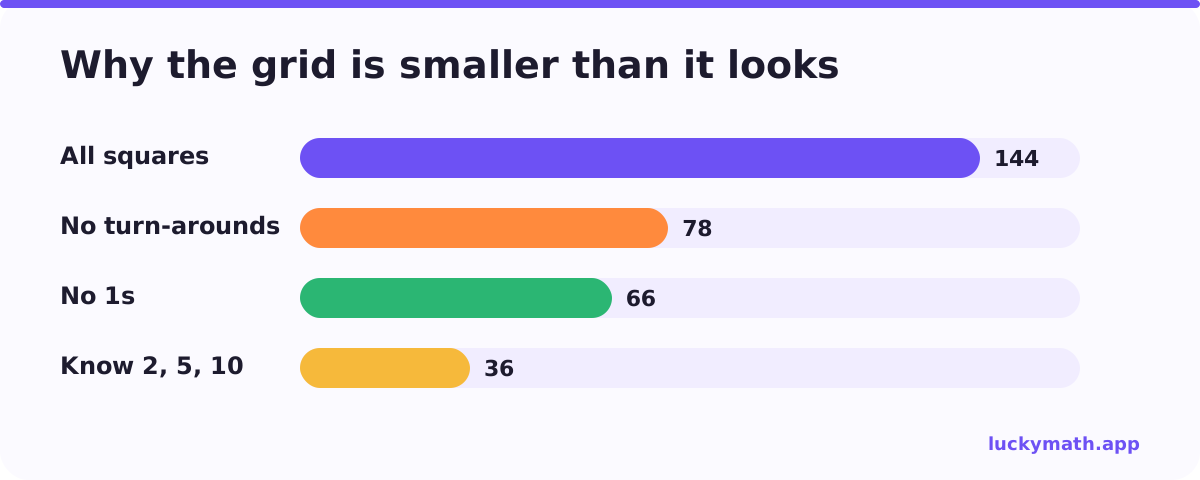
There are far fewer facts to learn than the 144 squares on a 12 × 12 grid. Turn-arounds count once, because 6 × 7 and 7 × 6 are the same fact. That leaves 78. The 1s take no learning, which leaves 66. If your child knows the 2s, 5s and 10s, only 36 are left. This is why the same grid can take 8 weeks for one child and 12 for another.
The calculator then uses these rules:
| Rule | Value used |
|---|---|
| New facts per session | 2 at a typical pace in 10 minutes, 1 at the Slower setting for a child who needs more repeats, 3 at the Faster setting |
| Session length | Scales the new facts up or down, capped at 4 a session |
| Review sessions | Every third session has no new facts |
| Order | 10, 2, 5, 11, 4, 3, 6, 9, 8, 7, 12, the order from our step-by-step times tables guide |
| Final stretch | 2 weeks of mixed checks, until each fact is quick on three different days |
These are our planning rules. No study says a child learns 2 facts in 10 minutes, so treat the date as an estimate you can adjust. The rules do lean on research: - A study of 55 third and fourth graders by Burns and colleagues (2016) found that fitting the number of new facts to each child was more efficient than fixed sets of two or eight, so the calculator has a pace setting. - A 2015 analysis of 15,402 pupils, also led by Burns, found that children with weaker math skills needed more repetitions, and that facts with 4s, 5s, 6s and 7s took more repetitions than facts with 2s and 3s. - In a small study of Grade 3 pupils, Rea and Modigliani (1985) reported that retention of multiplication facts was almost double with spaced practice compared with massed practice, so the plan builds in review sessions.
What changes the date most
The starting point matters a lot. All of these use a typical pace, 10 minutes a session and five days a week:
| Tables your child already knows | Weeks to 10 × 10 | Weeks to 12 × 12 |
|---|---|---|
| None yet | 9 | 12 |
| 2s, 5s, 10s | 6 | 8 |
| 2s, 3s, 4s, 5s, 10s | 4 | 6 |
| All but the 7s and 8s | 3 | 4 |
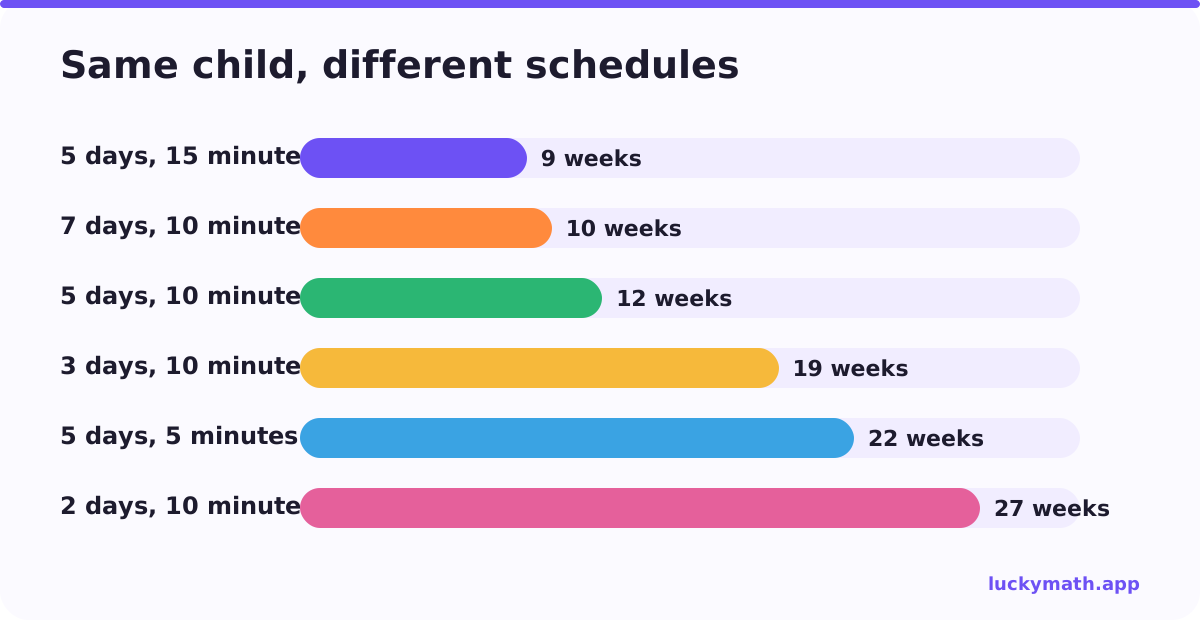
After that, it comes down to how much practice fits into each week. The number of sessions stays the same, so each day you drop pushes the finish date out. Going from five days a week to three adds about 7 weeks.
If 10 minutes won't fit into a day, try splitting it. Schutte and colleagues (2015) found that third graders practising addition facts two or four times a day improved faster than children doing one session a day, with the same total time. A 5-minute session before school and another after dinner may be easier to keep up than one longer block.
If you have a test date
Enter it in the calculator and it will tell you whether you are on track and, if not, the smallest schedule change that gets you there. The final two weeks of mixed checks are already included, so a finish date just before the test is cutting it fine.
Two common targets:
- In England, Year 4 children take the Multiplication Tables Check: 25 on-screen questions from the 2 to 12 times tables, with 6 seconds for each.
- The US Common Core standards expect children to know from memory all products of two one-digit numbers by the end of Grade 3.
If the date looks out of reach, cut the target. Change the calculator to 10 × 10, secure those facts and add the 11s and 12s after the test. Don't start timing your child to catch up, because speed comes after accuracy. Our guide on moving on from finger counting has ideas for the middle stage.
When the plan slips
Illness, holidays and busy weeks are normal, so treat the finish date the way you would treat a loan balance and recalculate.
- Check once a fortnight. Ask a few mixed questions from the rows you have ticked. If your child answers without counting, carry on.
- Lower the pace setting. If facts keep falling out, switch the pace to Slower. The date moves and the plan becomes realistic again.
- Restart from today. Tap the tables that are secure, set a new start date and let the calculator rebuild the rest. There is no need to do double sessions to catch up.
- Spend extra time on the sticky ones. The 7s and 8s can feel slow even though few new facts are left. Our 9 times table trick shows how patterns can help with that kind of fact.
Use each row as a milestone
Debt-payoff plans keep people going by marking small wins along the way, and a times tables grid can do the same. Every row in your plan is a table finished, so agree something small for each one. Our guide on rewards for math practice explains when rewards help and when they backfire.
Lucky Math is built around that idea. Your child does a short quiz at their level, and a good score unlocks a chest filled with rewards you choose. Addition and subtraction are free. Multiplication and division are part of Lucky Math Plus, so the quiz can be one part of your child's times tables practice.
FAQ
How long does it take to learn times tables?
With 10 minutes of practice five days a week, we estimate about 12 weeks from a standing start and about 8 weeks if your child already knows the 2s, 5s and 10s. A child who needs more repeats may take 5 months or longer. Those figures are planning estimates, so use the calculator for your own child.
Can a child learn all the times tables in a week?
A child may be able to chant a few tables in a week, but quick recall of every fact on any day takes longer. Spaced practice over weeks holds up better than cramming, and there are 66 separate facts to secure up to 12 × 12.
How many minutes a day should my child practise times tables?
About 10 minutes on most days suits many children, and two 5-minute sessions are fine if that fits your day better. See our guide to math practice time by age for more detail.
How accurate is the times tables calculator?
It is an estimate based on simple rules that we show on this page, so a real child can be faster or slower. Each result shows a slower and a quicker case. The plan is most useful for seeing how changes to your schedule move the date.