Mental Math Strategies for Addition Every Kid Should Know
Six mental math strategies for addition, from counting on to rounding and adjusting, with the order to teach them, examples and how to choose the right one.
Mental math strategies for addition are the shortcuts that let a child work out 8 + 7 or 47 + 29 without paper or fingers. Most of the lists online are written for teachers and give you the strategies in no particular order. Parents need something else: which one to teach first, what it looks like at the kitchen table, and how a child learns to pick the right one for a sum.
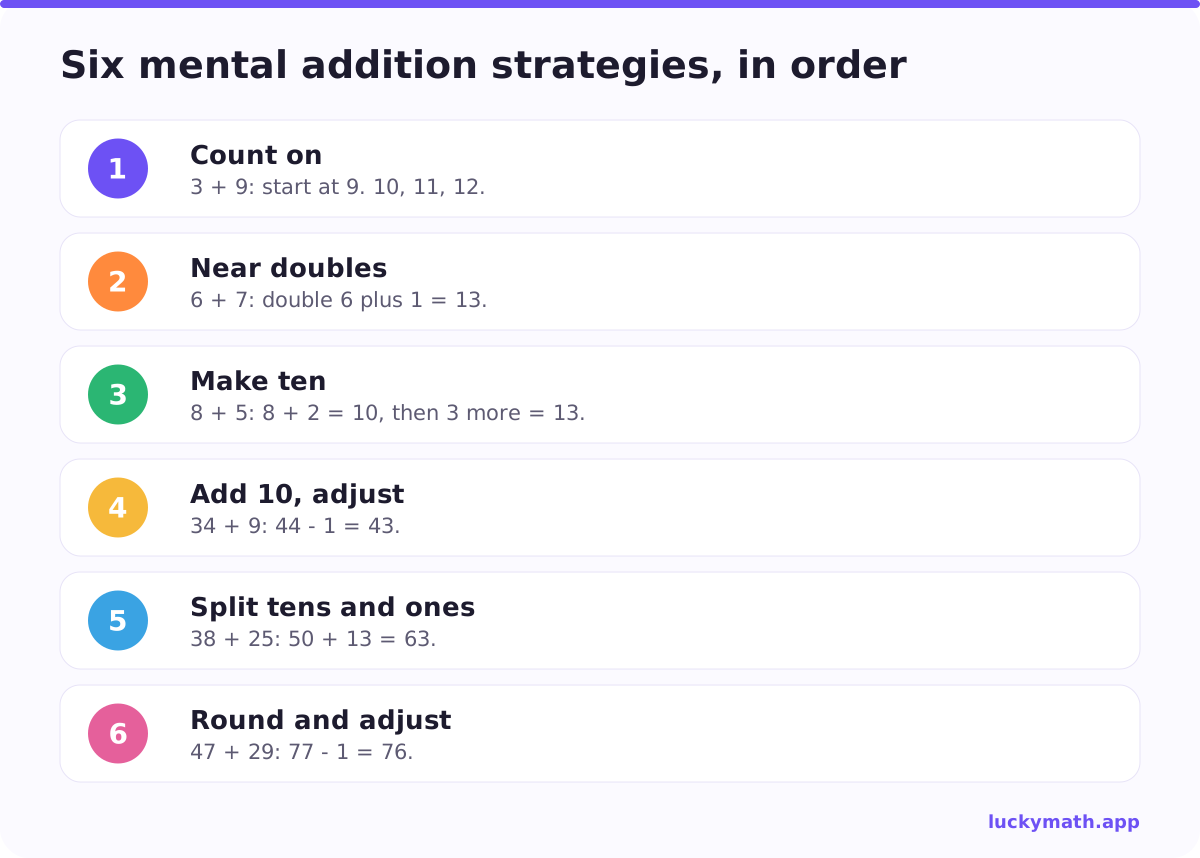
Here are six strategies in the order most children can learn them. Each one leans on the one before it, so if your child gets stuck, go back a step.
Before you start: two things to check
Mental addition rests on two skills. Your child should know number bonds to 10 without counting (7 and 3, 6 and 4), and understand that 34 means 3 tens and 4 ones. If bonds are shaky, start with our guide to number bonds to 10 and 20. If your child still counts everything from one, read how to help a child who counts on their fingers first.
The six strategies, in teaching order
1. Count on from the bigger number
Good for adding 1, 2 or 3. For 3 + 9, start at 9 and say "10, 11, 12". Children often start from the first number they see, so teach them to swap: 3 + 9 is the same as 9 + 3.
2. Use doubles and near doubles
Learn doubles to 10 + 10 by heart. Then use them for neighbours: 6 + 7 is double 6 plus 1, which is 13. 8 + 7 is double 7 plus 1, or double 8 minus 1. Either way gives 15.
3. Make ten
Good for sums that cross 10, such as 8 + 5. Take 2 from the 5 to fill up the 8: 8 + 2 = 10, then 3 more makes 13. The same idea works later for 38 + 5: 38 + 2 = 40, then 3 more makes 43.
4. Add 10, then adjust for 9 and 11
To add 9, add 10 and take 1 away: 34 + 9 is 44 - 1 = 43. To add 11, add 10 and 1 more: 34 + 11 = 45. Children enjoy this because it feels like a trick, and it makes adding 19 or 29 easy later.
5. Split into tens and ones
Good for two-digit sums without too much carrying. For 38 + 25, add the tens (30 + 20 = 50), add the ones (8 + 5 = 13), then put them together: 63. This is the method most children use for the rest of primary school, so give it plenty of time.
A variation keeps the first number whole and jumps along it: 46 + 37 becomes 46 + 30 = 76, then 76 + 7 = 83. Many children find this easier because there is less to hold in their head.
6. Round and adjust
Good when one number is close to a ten. For 47 + 29, add 30 instead (77), then take away the 1 you added too many: 76. For 56 + 38, add 40 (96) and take away 2: 94.
Which strategy for which sum?
Good mental maths means looking at the numbers before starting. Teach your child to ask "what's the easiest way?" and accept any way that works.
| The sum looks like | Try |
|---|---|
| Adding 1, 2 or 3 | Count on |
| Two numbers close together (7 + 8) | Near doubles |
| Crosses 10 (8 + 5) | Make ten |
| Adding 9, 19, 29 | Add the ten, adjust |
| Two two-digit numbers (38 + 25) | Split, or jump |
| One number ends in 8 or 9 (47 + 29) | Round and adjust |
How to practise at home
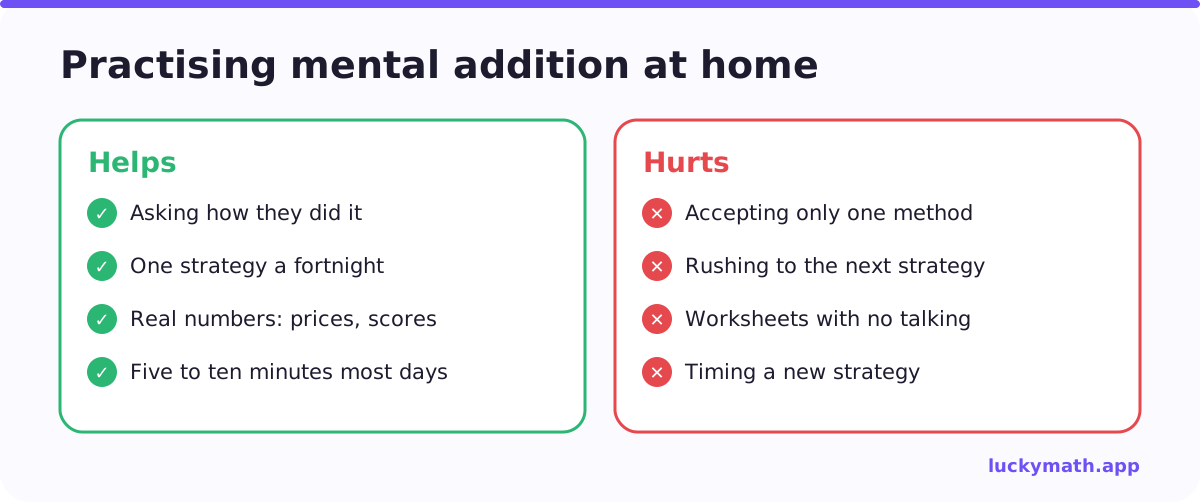
The most useful question you can ask is "how did you do it?" Children who explain a method remember it better, and you will hear straight away whether they are using a strategy or counting in their head. Try these:
- Number talks. Say one sum at dinner. Everyone works it out in their head, then shares how. There is often more than one good way, and adults can join in.
- One strategy a fortnight. Pick one and spot it everywhere. "That's a make ten!" Add the next only when this one is comfortable.
- Real numbers. Add prices at the shop, scores in a game, or minutes until you arrive.
- Keep it short. Five to ten minutes on most days is enough. See how long kids should practise math each day.
Don't time your child while they are learning a new strategy. Speed comes from using the method often, and a stopwatch pushes many children back to counting on their fingers.
What children can usually do by age
| Age | Typical mental addition |
|---|---|
| 5-6 | Counts on from a number. Knows some doubles and bonds to 10. |
| 6-7 | Bonds to 20, doubles, adding 10 to a number. |
| 7-8 | Adds a one-digit number to a two-digit number, adds tens. |
| 8-9 | Adds two two-digit numbers in their head, using splitting or jumping. |
| 9+ | Rounds and adjusts, adds larger numbers, chooses a method without help. |
These are rough, and children vary. If your child is a year behind this, go back to the strategy before the one they find hard.
Practising with an app
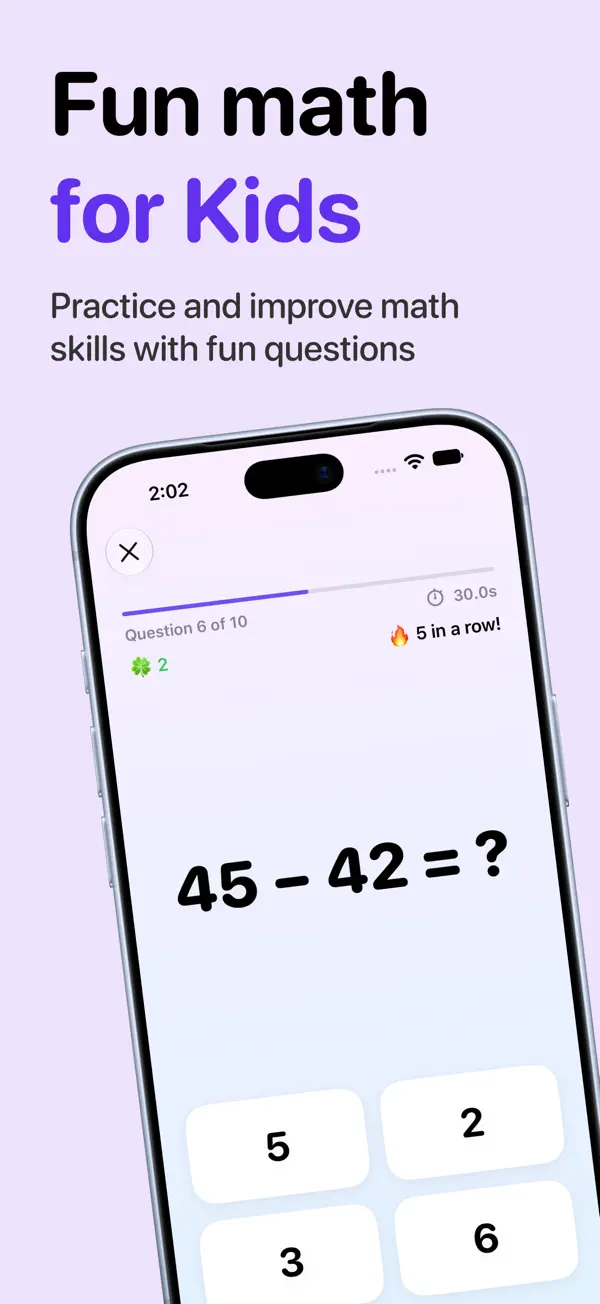
Once a strategy feels comfortable, short mixed practice helps make it automatic. Lucky Math is our iPhone app for quick daily quizzes, and a good score opens a lucky chest with a real reward you choose. Addition and subtraction are free. Lucky Math Plus adds multiplication and division, an Apple Watch app and family sharing.
FAQ
What is the best mental math strategy for addition?
There is no single best one, because it depends on the numbers. Make ten suits sums that cross 10, splitting suits two-digit sums, and round and adjust suits numbers near a ten. The goal is for your child to choose.
How can my child add faster in their head?
Check that number bonds to 10 and doubles are automatic first, since every other strategy uses them. Then practise one strategy at a time for a few minutes a day. Speed follows once the method feels easy.
What is the difference between mental math and memorising facts?
Facts such as 7 + 8 = 15 are recalled instantly. Mental math strategies are how a child works out sums they cannot recall, like 47 + 29, usually by building on the facts they do know. Children need both.
Should kids learn mental math before column addition?
Most children benefit from mental strategies first, because they show what the numbers mean. Column addition is useful for bigger numbers, but a child who only knows columns may reach for paper for a sum like 50 + 30.